
A swipe library becomes useful when it changes a conversation. The simplest way to create that moment is a short weekly review where the team compares a few references and leaves with a sharper hypothesis.
The ritual should be small enough to repeat. Thirty focused minutes with five well-annotated references is more valuable than an hour of unstructured scrolling.
Before the meeting: curate, do not dump
Choose three to seven references connected to one question. Avoid a general “what caught our eye” roundup. A useful theme might be how competitors establish proof, introduce price, demonstrate setup, or address a specific objection.
For each reference, confirm that the source, observation, and relevant structured fields are present. Remove duplicates and examples that do not add a distinct comparison point.
Minute 0–5: state the question and boundaries
Open with the decision the research should inform. Clarify what evidence is available and what is not. Public creative can show messages and formats; it cannot establish performance without supporting first-party data.
This framing keeps the conversation away from “I like it” and toward “What does this example help us understand?”
Minute 5–15: describe before interpreting
Review each reference quickly. Ask participants to describe the opening, angle, format, offer, proof, CTA, and likely funnel job. Capture disagreements rather than resolving them too early.
Description gives the group a common evidence base. Interpretation becomes more productive once everyone is discussing the same observable details.
Minute 15–23: compare the set
Look for recurrence and contrast.
- Which audience tensions appear more than once?
- Where does proof enter the sequence?
- Which conventions seem category-wide?
- Which reference deliberately breaks the pattern?
- What important message is missing from the set?
A pattern is not automatically a recommendation. It may represent a useful convention, a crowded idea, or an opportunity to differentiate.
Minute 23–28: write one original hypothesis
Turn the strongest observation into a testable statement. A good hypothesis names the audience insight, the intentional change, and the signal you expect to observe using your own data.
For example: “For new users worried about setup time, leading with the completed workflow before explaining features may improve qualified starts.” The language describes a strategic test; it does not instruct the team to copy another execution.
Minute 28–30: assign the next action
End with an owner and destination. The outcome might update a brief, create a new concept route, request customer evidence, or identify a question for the next review.
Record the decision in the collection so a future teammate can trace the brief back to the research. If no decision emerged, write down what evidence was missing.
Worked review: three references, one decision
Suppose your question is “Should our next opening show the problem before explaining the features?” The following samples are invented teaching examples, not competitor performance evidence.
- Sample A: opens on a crowded shelf, then shows the product solving the problem; no explicit discount; Learn more CTA.
- Sample B: opens with a customer quote before the product; mentions a trial; a trial-start CTA.
- Sample C: names three features before showing the product; mentions a bundle; Shop now CTA.
Describe each sample first, using a consistent taxonomy. A and C provide a useful sequence contrast, but their offers and CTAs also differ. B introduces a separate proof question. None of them establishes which sequence performs best.
The review decision is to explore problem-first versus explanation-first openings using your own product, footage and approved claims. Hold the offer, CTA, length and intended audience consistent where possible. That makes the proposed test more focused than reproducing all the differences between A and C.
A reusable private Playbook template
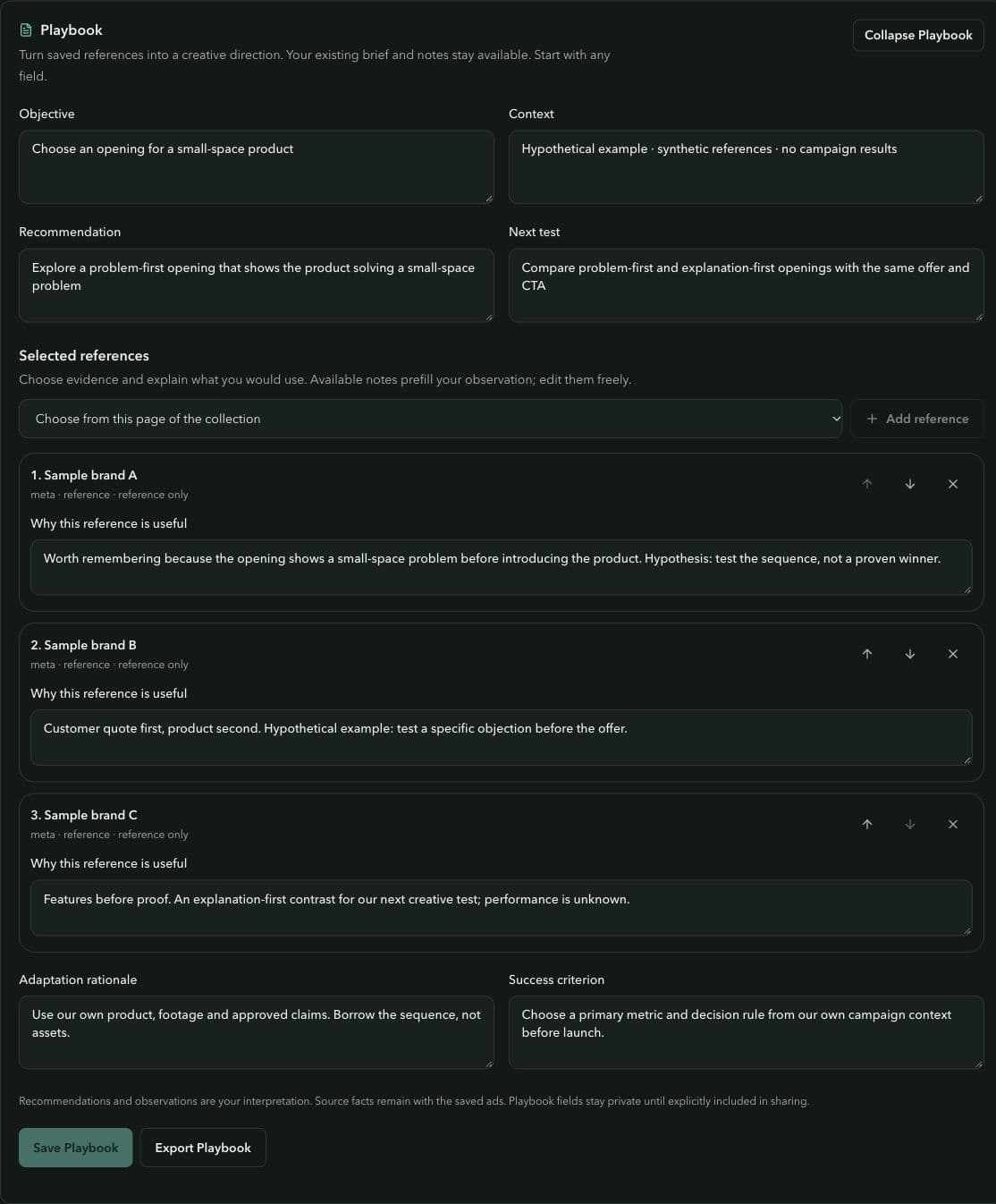
In SwipeTrove, save your selected references into a focused collection, choose Create Playbook, fill the draft and choose Save Playbook. Free supports private drafting; the app does not launch a campaign or verify competitor results. The worked competitor-research guide shows this sequence in more detail.
Use these prompts to carry the review into the next brief:
- Recommendation: What single creative change should we explore? Example: show the small-space problem before explaining the product.
- Evidence: Which selected references illustrate it, and what can we actually observe? Example: A shows a problem-first sequence; C provides an explanation-first contrast. Neither supplies performance proof.
- Adaptation: What will we create ourselves? Example: original footage of our product and claims we can support, rather than another advertiser’s copy or assets.
- Next test: What will vary and what should stay consistent? Example: two openings, with the same offer, CTA and length where possible. Record the owner and planned review date here.
- Success criterion: Which first-party metric, evaluation window and decision rule will we agree before launching? If those are unknown, leave the draft pending until the person running the test defines them.
On the next review, retrieve the same collection and compare the hypothesis with your own results. Record the conditions and uncertainty; a difference in outcomes does not automatically identify the opening as the cause. SwipeTrove does not import or validate campaign performance. Pro’s manual tests and lessons are coming soon; a Free user can revisit their private draft and research notes.
Keep the ritual honest
Rotate who curates the set, revisit past hypotheses, and compare them with first-party outcomes. Archive weak collections rather than letting every review become permanent clutter.
The measure of the ritual is not how many ads the team discussed. It is whether the next piece of work began with a clearer question and a more explicit reason for the creative choices it made.
Create a focused research collection in SwipeTrove for your own review. If you need to send it to another person, Pro offers exports and optional public collection links; these do not create a shared team workspace. Check current plan availability.