
Taxonomy sounds like administrative work until a brief asks for every comparison ad aimed at a problem-aware audience with a trial offer. At that moment, consistent classification becomes creative leverage.
The best system is not the most detailed. It is the smallest set of distinctions that changes what you can find, compare, or decide.
Hook: what earns the next moment of attention?
Classify the mechanism, not the exact sentence. Useful hook types might include problem recognition, bold claim, curiosity, demonstration, confession, contrast, question, or social proof.
Keep the label close to what is observable. A close-up of a broken object may function as problem recognition; do not infer an emotional state the creative does not establish.
Angle: which strategic lens frames the value?
The angle connects an audience tension to a product promise. Examples include speed, simplicity, control, belonging, risk reduction, identity, convenience, or economic value.
Two creatives can use the same hook type but express different angles. A direct question may frame either lost time or lost confidence. That difference is strategically important.
Format: how is the message delivered?
Choose labels that describe the creative container: founder-led, testimonial, product demonstration, comparison, animation, static graphic, interview, screen recording, or montage.
Format is not quality. It helps you compare how different containers express the same angle or how one format changes across funnel stages.
Offer: what changes the decision now?
Separate the product promise from the commercial offer. The offer may be a discount, trial, bundle, guarantee, bonus, limited release, consultation, or no explicit incentive.
Recording “no explicit offer” is useful. It prevents research from overrepresenting promotion-heavy creative simply because promotions are easy to label.
CTA: what is the requested next step?
Normalize variants into actions such as learn, shop, start, book, compare, download, subscribe, or contact. Preserve the exact CTA in notes only when its wording matters.
This field becomes valuable when you compare message intensity with action intensity. A broad awareness story paired with an immediate purchase CTA deserves a different reading from the same story paired with “Learn more.”
Funnel stage: what job is the creative trying to do?
Use a small model your team already understands. Awareness, consideration, and conversion are often sufficient. Add retention only if post-purchase creative is genuinely part of the research program.
Treat funnel stage as an interpretation. Record the evidence behind uncertain classifications rather than forcing confidence.
Structured fields versus tags
Structured fields are best for a stable set of mutually useful choices. Tags are best for emerging themes, campaigns, audiences, markets, and temporary research language.
If a tag appears in nearly every project and drives frequent filtering, consider promoting it into the structured system. If a structured option is rarely used or interpreted inconsistently, simplify it.
Worked example: classify a small-space product reference
This is an invented teaching example, not an ad retrieved from Meta. Imagine a video that opens on a crowded shelf, shows a storage product clearing the space, and ends with “Learn more,” without a visible discount or trial.
In SwipeTrove, open the saved reference and edit your research fields. The following labels match the available choices; the surrounding explanation belongs in your note.
- Hook: Problem. The opening shows the crowded shelf. Choose Demonstration instead if the product action is the first thing the viewer sees; classify the opening, not the whole video.
- Angle: Convenience. Our interpretation is that easier organization is the intended benefit. The creative does not establish what viewers actually care about.
- Format: Product demo. The sample shows the product in use. Do not label it UGC merely because the footage looks informal.
- Offer: No explicit offer. No incentive appears in the imagined creative. That does not prove the destination has no offer.
- CTA: Learn more. Record the visible next step rather than inventing a purchase objective.
- Funnel stage: Consideration. This is our working interpretation because the sample explains use. Public creative does not reveal the advertiser’s campaign settings.
A useful note might read: “The shelf problem appears before the product explanation. Worth testing whether that sequence makes our own benefit clearer. Audience, targeting and performance are unknown.” Keep the source link and observation date when applying this exercise to a real, authorized reference.
Retrieve the example for a brief
Put the reference in a collection named for the decision, such as “Small-space opening test.” Use a flexible tag such as small-space for the recurring theme. Avoid a tag called winner: no performance evidence supports it.
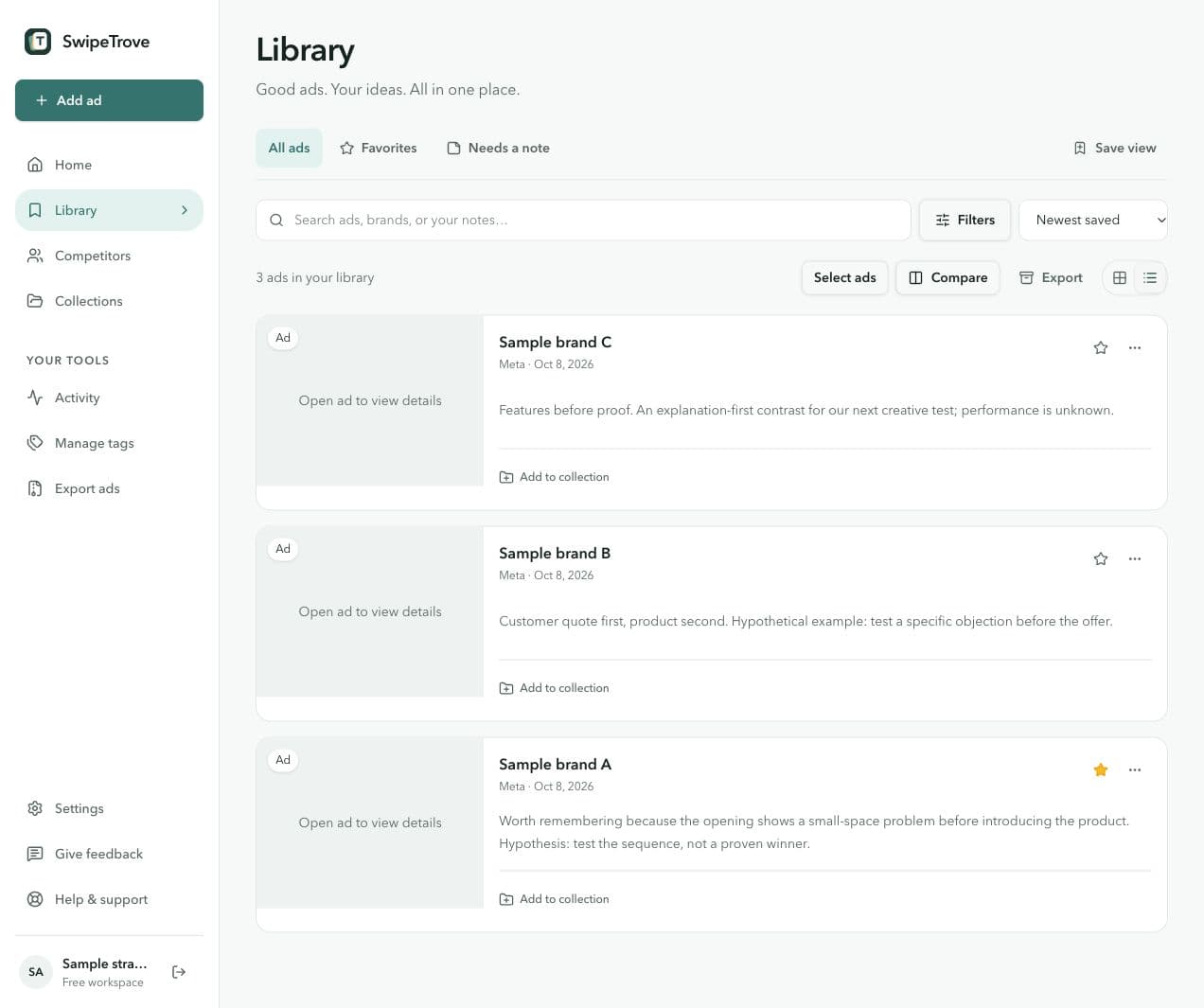
In the Library, combine Hook = Problem, Format = Product demo and CTA = Learn more to find comparable references. Search for the words you used in the note, select a small shortlist, and open Compare. A missing field is a cue to revisit the reference, not permission to fill it with a guess.
Free includes up to 25 saved references and 3 collections, with notes and comparison. Follow the save-and-note walkthrough to try the sequence in your own workspace. Then use the weekly review template to turn the shortlist into a test question.
Calibrate with real examples
Once a month, have two people independently classify the same five references. Discuss disagreements and update the definitions—not the labels—until the system becomes predictable.
Consistency matters more than theoretical precision. A modest taxonomy used by everyone will outperform an elaborate one used by nobody. Explore structured creative filters in SwipeTrove. Apply these distinctions in a worked competitor-ad comparison.