SwipeTrove Research Notes · Product workflow guide
Competitor research should help you choose what to try, while keeping the limits of public evidence clear. This example uses three invented brands and synthetic references. It is a teaching example, not a customer case study or a claim about campaign results.
1. Set a research question
Suppose you are preparing a creative brief for a small-space product. Your question is: “Should our next opening show the problem before explaining the features?” Choose a few relevant public references rather than trying to collect every competitor ad.
Find references in Meta Ad Library. Check each advertiser and exact ad link. Follow the save-and-note guide to keep the reference and your observation together.
2. Keep source context and unknowns
Record only what you can support: the visible hook, offer, CTA, source link, and the date of your observation. Keep your interpretation in your own research fields or note.
In Competitors, add a name and Facebook Page link to group selected saved references. Advanced context is optional. A Page share link may not identify the destination yet; check that it leads to the intended Page before relying on its identity. A profile groups your research, not a complete live inventory.
Use dated source checks when you review an exact ad again. A capture date or saved date is not the campaign start date. “Still visible when I checked” is evidence of that observation, not continuous delivery between checks.
- An Ad Library country selection or creative language is not proof of advertiser targeting.
- An ad that stays visible is not automatically profitable or a “winner”.
- Visible copy does not verify spend, ROAS, audience size, or the campaign’s backend objective.
3. Compare a small shortlist
Select two to four saved references in the Library and open Compare. Look at the same dimensions for each: first-frame mechanism, product proof, offer, CTA, and your note. Missing source facts should remain unknown.
The following cards are an authored hypothetical comparison. They are not records retrieved from Meta.
Sample brand A
- Observable opening
- Shows a crowded shelf, then the product in use
- Visible offer
- No explicit discount in the sample
- CTA
- Learn more
- Our interpretation
- Test whether a visible problem makes the benefit easier to grasp
Sample brand B
- Observable opening
- Opens with a customer quote before showing the product
- Visible offer
- A trial is mentioned in the sample
- CTA
- Start a trial
- Our interpretation
- Test a specific customer objection before introducing the offer
Sample brand C
- Observable opening
- Names three features in the opening
- Visible offer
- A bundle is mentioned in the sample
- CTA
- Shop now
- Our interpretation
- Use as an explanation-first comparison, not a proven weaker ad
The interesting difference is the order of explanation and proof. It suggests a question worth testing; it does not establish which sample would perform best.
4. Draft the next test
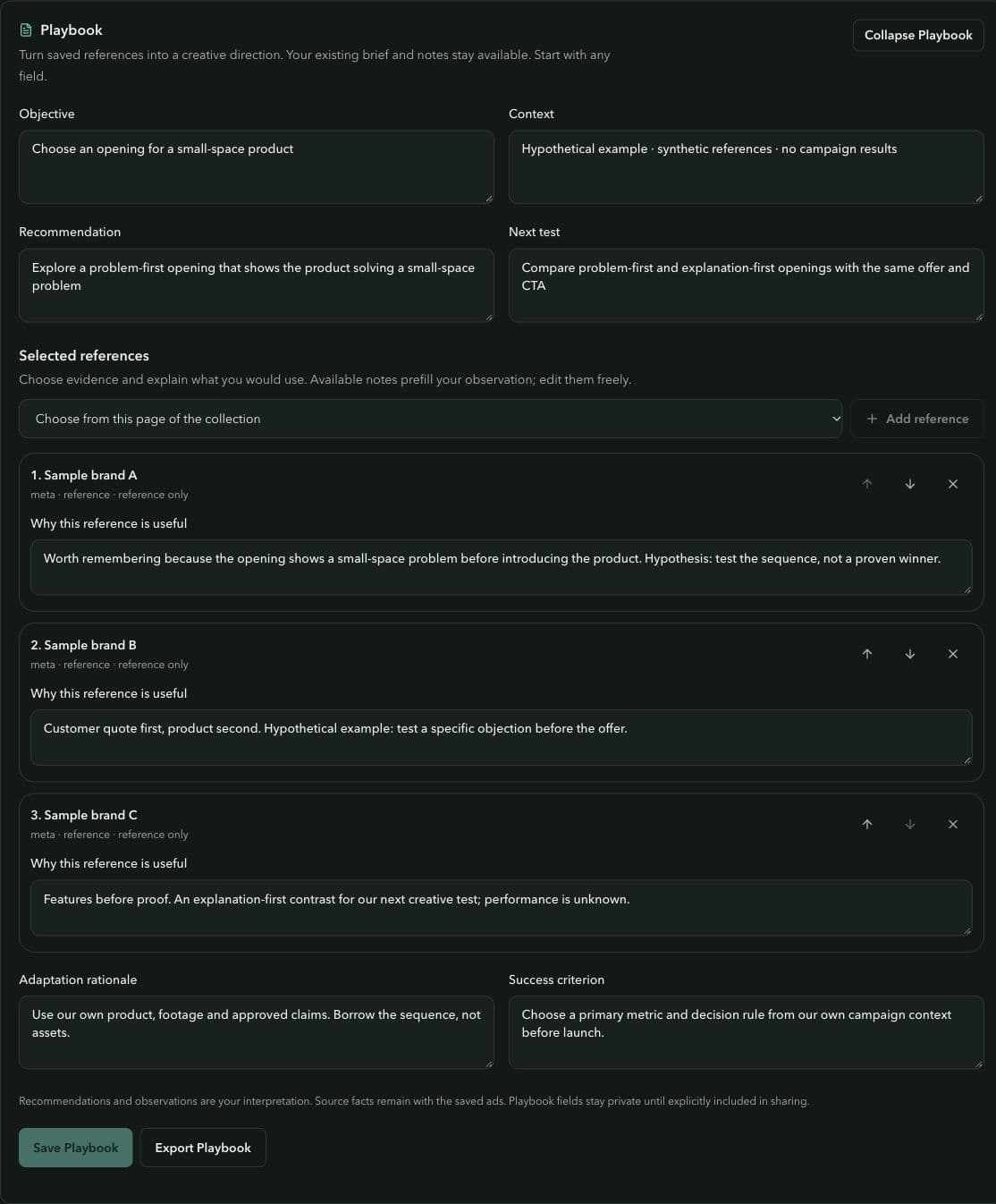
Move the useful shortlist into a collection. Choose Create Playbook and draft a recommendation, the references that support it, what you would adapt, the next test, and a success criterion. Save Playbook to persist your draft.
Example private draft
- Recommendation
- Explore a problem-first opening that shows the product solving a small-space problem.
- Evidence
- Sample A demonstrates the problem-first sequence; Sample C gives us an explanation-first contrast. These are creative observations, not performance evidence.
- Adaptation
- Use our own product, footage, and approved claims. Borrow the sequence rather than another advertiser’s assets or copy.
- Next test
- Compare two openings while keeping the offer, CTA, length, and intended audience consistent where possible.
- Success criterion
- Choose a primary metric and decision rule from your own campaign context before launching. Record the test conditions and use your first-party results to decide what to keep.
5. Revisit the evidence
When another brief begins, retrieve the collection and ask whether the observations still apply. Check the original source again if your decision depends on its current visibility. Keep the original observation date; add a new check instead of pretending the earlier evidence is fresh.
Campaign results come from your own measurement. SwipeTrove does not automatically verify competitor spend or track campaign performance. Free includes your research and private drafts; Pro’s private manual tests and lessons are coming soon.
Make the review repeatable with the 30-minute weekly review and private Playbook template.
For a consistent vocabulary, read the guide to hooks, angles, offers, and funnel stages. Review responsible-use requirements before collecting or adapting references.